Student-led guidance
Your questions are answered by final-year MBBS students who have lived the journey — applications, hostels, wards and exams.
Student-led guidance for MBBS in Bangladesh
WhatsApp Us
Explore medical colleges, fees, eligibility and the admission process in Bangladesh with transparent, student-led guidance. Ask real questions and get straight answers — including the ones agents avoid.

We are medical students, not agents. Here is exactly what that means for you and your family.
Your questions are answered by final-year MBBS students who have lived the journey — applications, hostels, wards and exams.
We do not charge students a consultancy fee for our guidance. Not at enquiry, not at admission, not later.
No separate documentation charge from our side. We will help you understand what each college asks for.
We separate our guidance (free) from official third-party costs (payable) so nothing surprises you later.
Six colleges from our directory — deliberately not a ranking. Fees are taken from each college’s official fee letter for the 2026–27 session.
Official fee letter · 2026–27 session
MBBS · 5 years + 1 year internship
Official fee letter · 2026–27 session
MBBS · 5 years + 1 year internship
Official fee letter · 2026–27 session
Official fee letter · 2026–27 session
Official fee letter · 2026–27 session
Official fee letter · 2026–27 session
College packages from official fee letters currently range from $33,500 to $46,250 in total. That is only the college’s share — here is everything that goes into the real cost.
From official college fee letters, 2026–27 session. Fees can change — confirm with the college before paying.
Dhaka is generally more expensive than smaller cities. Ask current students what they actually spend.
These are paid directly to the relevant authority or provider — never to us.
These are the reasons students most often give us. Whether they apply to you depends on your marks, your budget and the specific college — so treat this as a starting point for a conversation, not a recommendation.
MBBS in Bangladesh is taught and examined in English. Learning conversational Bengali still helps a great deal during clinical postings.
The course structure — pre-clinical, para-clinical and clinical years followed by a compulsory internship — will feel broadly familiar to Indian students.
Bangladesh is a short flight from several Indian cities, and travel is generally simpler than more distant study destinations.
Food, festivals, climate and daily life have a lot in common with eastern India, which many students find makes settling in easier.
Teaching hospitals in Bangladesh generally see high patient volumes. How much hands-on exposure you get varies by college — ask current students.
Many colleges already have Indian students, so there is usually a senior batch to ask about hostels, food and study material.
Depending on the college, total cost can work out lower than some private MBBS options in India. Compare the full six-year cost, not just first-year tuition.
There are government and private medical colleges across Dhaka, Rangpur, Chattogram, Sylhet, Rajshahi, Khulna and other districts.
Most cities with medical colleges have established student areas, though facilities and safety vary — which is why the specific college matters more than the country.
Transparency is easier to demonstrate than to claim, so here it is in plain terms.
When you are choosing where to spend the next six years of your life, the most useful person to speak to is not a salesperson. It is someone who sat the same exam, filled the same forms and now walks those wards every morning.
We started MBBSinDhaka.in because juniors and their parents kept asking us the same questions — and because the answers they were getting elsewhere were often vague, outdated, or shaped by a commission. So we decided to answer them properly, in public, for free.

Dhaka is the capital of Bangladesh and the centre of its medical education system. It is not automatically the right choice — but it is the right place to understand the landscape.
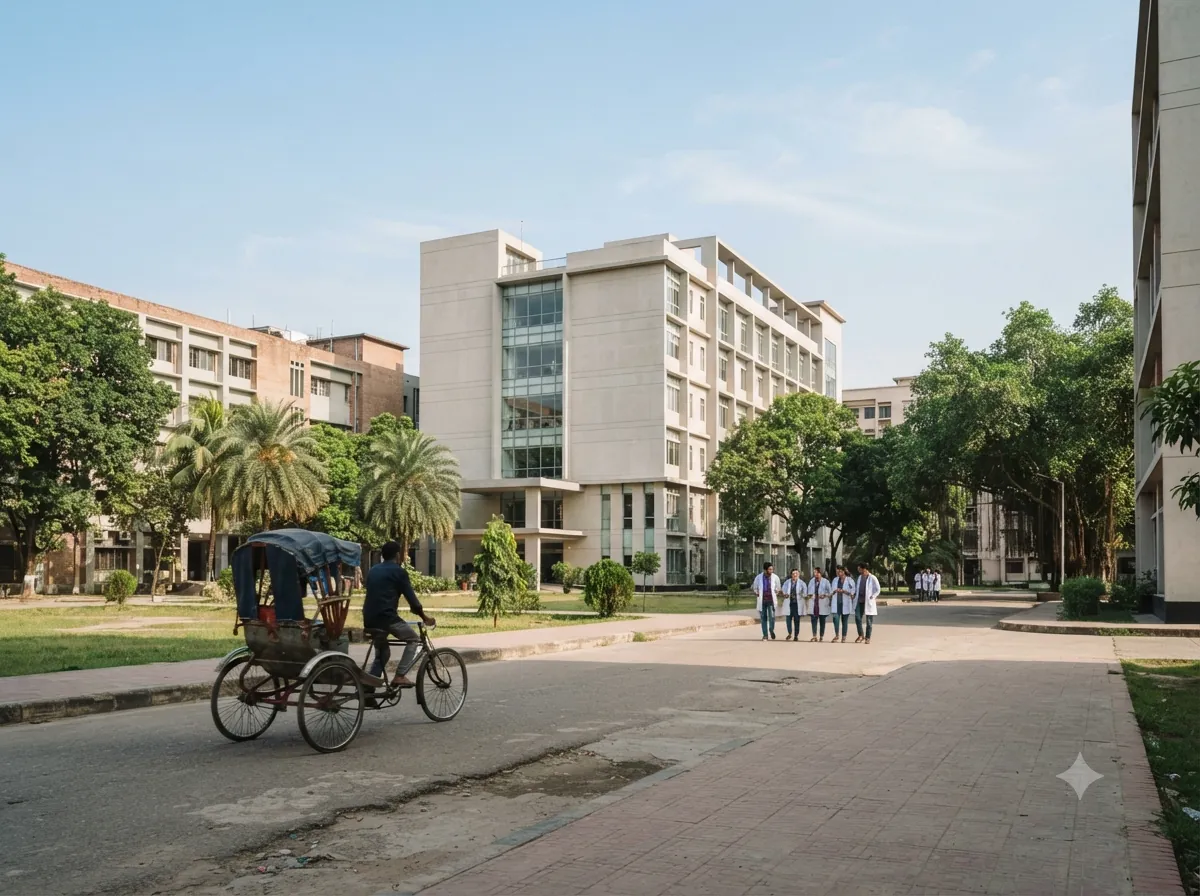
Dhaka has a high density of medical colleges and large teaching hospitals, which is why the city dominates most college shortlists.
Colleges in and around Dhaka usually have Indian students across several batches, which makes the first few months easier.
Dhaka has the country’s main international airport and good onward links, which matters when you travel home during breaks.
Most colleges provide hostels for international students. Distance between hostel, college and hospital varies a lot — always ask.
Living costs in central Dhaka are usually higher than in smaller cities. Colleges in Rangpur, Rajshahi or district towns can work out cheaper to live near.
Colleges in Keraniganj and other outer areas keep you close to the capital, often with a quieter campus setting.
Colleges in Bangladesh also apply their own academic criteria for international applicants, which can be stricter than the minimum.
Most students who write to us are not sure whether they qualify at all. Send us your NEET score and your Class 12 marks, and we will tell you honestly what is realistic.
If you do not qualify, we will say so. If a different path suits you better, we will say that too. We would rather lose an enquiry than push a student towards a decision that does not fit.
Ten stages, in the order they happen. Timelines shift from session to session — this is the shape of the journey, not a calendar.
Check your NEET status, Class 12 subjects and marks, and age against current requirements before anything else.
Narrow down by city, college type, hostel arrangement and total realistic cost — not by whichever name you heard first.
Look at the full six-year cost, the attached hospital, hostel distance and how the college supports international students.
Marksheets, NEET scorecard, passport, photographs and anything else the college specifies for the current session.
Apply through the college’s official process for international students, within its published window.
If an offer is made, read exactly what it covers, what it costs and what the deadlines are before responding.
Verification, attestation and any clearances the college or authorities require for the current session.
Apply for the student visa with the documents specified by the authorities. Timelines are outside anyone’s control — start early.
Plan travel, currency, SIM, and your first week’s arrangements. Seniors at the college are usually the best source here.
Registration, hostel allotment, orientation — and then the part you actually came for.
Academics are only half of it. These are the questions students actually message us about in their first month.
Sharing arrangements, warden rules, laundry, water and how far the hostel is from the hospital.
Mess food is close to eastern Indian cuisine. Vegetarian options exist but need planning — ask before you commit.
Rickshaws, buses and ride apps. Most students live close enough to walk or take a short ride to college.
Local SIM, data plans, and how students usually call home. Sort this out in your first week.
Parents ask us this first, and they are right to. Here is the line drawn as plainly as we can draw it.
We do not charge students a consultancy fee for our guidance — at any stage.
No separate documentation charge from our side for helping you understand requirements.
No commission asked from you, no surprise charge later, no fee to keep talking to us.
These are paid directly to the college, authority or provider concerned — never through us.
We will publish these only with permission — never as invented reviews.
We will publish student and parent experiences only after receiving written permission from the student and their family. We do not publish invented reviews, stock photographs of students, or ratings we cannot verify.
The questions students and parents ask us most. There are many more on the full FAQ page.
It can be a reasonable option for some students, and a poor fit for others. Bangladesh runs its MBBS course in English, follows a broadly similar academic pattern to India, and is geographically close — which many Indian families find reassuring. But the right answer depends on your NEET score, your budget, your comfort with living abroad, and what you plan to do after the degree.
We would rather help you compare it honestly against your other options than tell you it is right for everyone.
For Indian students, NEET is central. Under the National Medical Commission's regulations for foreign medical graduates, an Indian student who wants to study medicine abroad and later obtain a licence to practise in India is required to have qualified NEET-UG. Bangladeshi authorities also apply their own academic criteria for international applicants.
Because these rules are updated from time to time, please confirm the current NEET and eligibility-certificate requirements before you apply.
The MBBS course in Bangladesh is normally five years of academic study followed by a one-year compulsory internship — six years in total. The internship is an important detail for Indian students, because Indian regulations expect the internship to be completed in the same institution where the course was studied.
MBBS in Bangladesh is taught in English. Textbooks, lectures and examinations are in English. Learning some conversational Bengali is still very useful, because you will be taking patient histories in wards where many patients speak Bengali. Most Indian students pick up enough within the first year.
Most Indian students study at private medical colleges, which usually quote a total package in US dollars, paid in instalments. For the 2026–27 session, the packages listed on our fees page range from about USD 33,500 to USD 45,000, depending on the college and on what the package includes.
That is only the college’s share. Hostel (where it is not included), food, registration and examination fees, living expenses, visa and travel all come on top. Fees also change between sessions, so confirm the current fee letter with the college before paying anything.
Typically: your Class 10 marksheet and certificate, your Class 12 marksheet and certificate, your NEET scorecard, a valid passport, passport-size photographs, and a birth certificate. Some colleges also ask for a medical fitness report, a migration or transfer certificate, and an eligibility certificate.
Exact requirements vary by college and by the current admission rules, so always work from the checklist the college itself publishes for the session you are applying to.
In outline: you confirm your eligibility, shortlist colleges, compare fees and facilities, prepare your documents, submit applications, and — if you receive an offer — complete the required formalities, apply for a student visa, and travel to join the college.
Each college publishes its own timeline and requirements, and dates shift from session to session. Our admission process page walks through each stage in detail.
Send one message. Tell us your NEET score, your Class 12 marks and what you are worried about — and we will tell you honestly what your options look like.
₹0 consultancy fee • ₹0 documentation fee • No hidden charges