
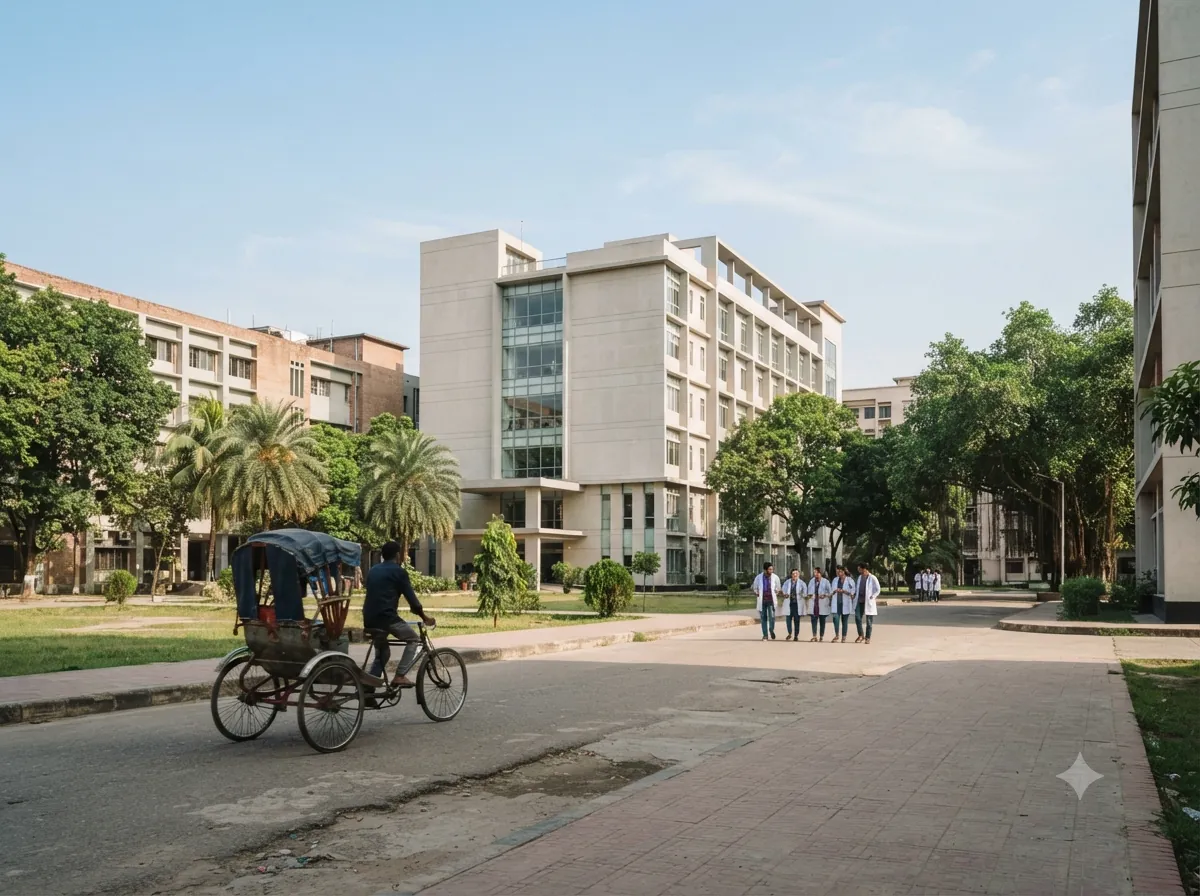
Why students start their search in Dhaka
Dhaka is the capital and by far the largest city in Bangladesh. It holds the greatest concentration of medical colleges and teaching hospitals in the country, which is why it dominates almost every shortlist an Indian student puts together.
- The highest density of medical colleges and large teaching hospitals in the country
- The main international airport, which matters for travel home during breaks
- Established communities of international students, including Indian students, across many colleges
- Better access to specialist hospitals, libraries, coaching and study resources
- More options if you later want to move hostel, change accommodation or find part-time study support
None of that automatically makes a Dhaka college the right choice — but it does make Dhaka the right place to understand the landscape before you compare anything else.
The medical education ecosystem
Government and private medical colleges sit side by side in the city, each attached to a teaching hospital. Government colleges in Dhaka are among the oldest institutions in the country and are attached to very large public hospitals, but their international seats are limited and allocated through official government channels rather than direct application.
Private medical colleges in Dhaka are where most Indian students end up. They vary widely — in campus size, hospital patient load, hostel arrangements, and how much structure they provide for international students. Two colleges four kilometres apart can offer quite different experiences.
The Dhaka colleges in our directory are in Gulshan, Tejgaon, Dhanmondi and Green Road, Eskaton, Mirpur, Maghbazar and Keraniganj, with another in neighbouring Narayanganj.
Hospitals and clinical exposure
Clinical exposure is the single most important thing to ask about, and the hardest to judge from a website. A large attached hospital with high patient volume gives you more to learn from — but only if students are actually allowed near the patients.
Useful questions to ask a current student at any Dhaka college:
- How many beds does the attached hospital have, and how busy are the wards day to day?
- How much of the clinical posting is observation versus doing things under supervision?
- How far is the hospital from the college and from the hostel?
- Are there additional postings at other hospitals, and how are they arranged?
- What do final-year students say about their preparation for the internship?
Student life, food and getting around
Day-to-day life in Dhaka is busy, crowded and, for most Indian students, surprisingly familiar. Food is close to eastern Indian cuisine — rice, fish, lentils and similar spices — and vegetarian options exist, though they take more planning in some hostels than others.
Getting around is mostly rickshaws, buses and ride-hailing apps. Traffic is genuinely heavy, which is why the distance between hostel, college and hospital matters far more here than the map suggests. Ten kilometres in Dhaka is not a ten-minute journey.
Most students settle into a small radius: hostel, college, hospital, a few local shops and eating places. Read our student life page for what the first month usually looks like.
Accommodation and safety
Most colleges provide hostel accommodation, and many make it compulsory for international students in the early years. That is generally a good thing — it puts you near seniors who can help, and it removes the hardest part of arriving in a new country.
Ask specifically about: room sharing arrangements, warden and security arrangements, curfew rules, laundry and water, mess timings and whether meals are included, and the distance and safety of the route between hostel and hospital for early or late duties.
Families who want additional reassurance often look at women's medical colleges, which admit female students only and typically have their own hostel arrangements. Our hostel page covers what to check before you accept a place.
Cost categories in Dhaka
Living costs in central Dhaka are generally higher than in smaller Bangladeshi cities. We are not going to publish specific monthly figures, because they move with exchange rates, inflation and your own habits — and a stale number is worse than none.
What we can tell you is what the categories are, so you can build a realistic monthly picture with a current student:
Fixed, paid to the college
- Tuition instalmentsPer college circular
- Hostel chargesPer college circular
- Examination feesAs applicable
Variable, month to month
- Food beyond the messYour choice
- Local transportDistance-dependent
- Books and study materialHeaviest in year one
- Phone, data, personalYour choice
Our living cost page explains how to build an honest monthly budget with a student who is already there.
When a college outside Dhaka makes more sense
Plenty of students are better served by a college outside the capital, and we say so regularly.
- Cost. Living expenses in smaller cities are generally lower, and that compounds over six years.
- Campus setting. Colleges in district towns such as Bajitpur, Faridpur or Bogra are often quieter and more contained, which some students strongly prefer.
- Proximity that is good enough. Outer areas such as Keraniganj keep you close to central Dhaka without living in the middle of it.
- The specific college is simply better. A well-run college in Chattogram or Sylhet beats a poorly-run one in Dhaka every time.
Choose the college, not the postcode. Use the directory to compare across cities.
Page last reviewed on by the MBBSinDhaka.in student team. Spotted something that has changed? Tell us on WhatsApp.